What a product launch video costs, and how long it really takes
The quote is rarely the real number. Revisions, approvals and the versions nobody scoped are where launch video budgets and timelines actually go.
Tom - Scenivia
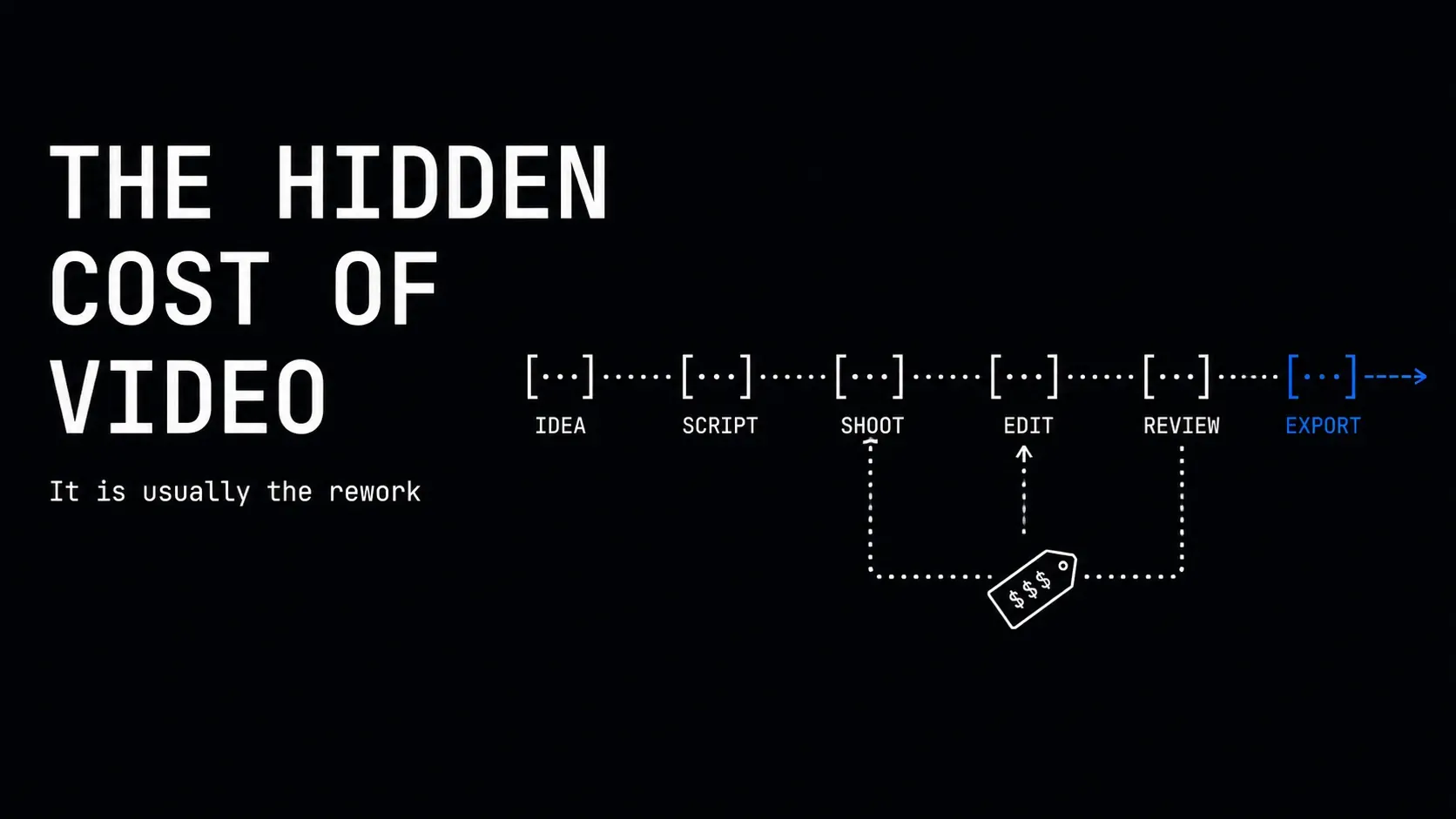
Anyone who gives you a single number for this is guessing, and usually guessing low. What follows is how to build your own estimate, and where the estimate is most often wrong.
The four things that actually drive the price
Not duration. A 60 second film is not twice a 30 second one, and is often cheaper per second because the fixed costs are the same.
1. How much is custom. Stock motion applied to your screenshots is one price. A bespoke visual system designed for your brand is a different business entirely. This is the largest single factor and the one most often left vague in a brief.
2. How many versions. One master film is one project. A master plus a vertical cut, a 15 second pre-roll, a silent autoplay version and four localised subtitle tracks is five or six deliverables, and each one needs its own framing decisions rather than a re-crop.
3. How many approval rounds. Two rounds is normal. Five means the message was not agreed before production started, and rounds three through five typically cost more than rounds one and two combined, because they arrive after the work is built.
4. Who supplies the material. If the team hands over clean, current screenshots and final copy, the project starts. If the video project is where somebody first discovers the copy is not agreed, that discovery is now on the critical path.
Where the timeline actually goes
For an outsourced 30 second launch film, the honest shape is roughly:
| Phase | Typical share of elapsed time |
|---|---|
| Agreeing the message | large, and usually unbudgeted |
| Script and storyboard | small |
| Production | moderate |
| Revisions and approvals | large |
| Final delivery and formats | small |
The two large rows are the two nobody puts in the plan. Both are about decisions rather than craft, which is why adding people or money to the production row rarely helps.
The practical implication: the calendar is set by your decision-making speed, not by render time. A team that can agree a message in two days ships faster than a team with double the budget and a weekly review meeting.
The versions nobody scopes
Budget for these before they are requested, because they always are:
- A vertical cut. Not a crop: the platform covers roughly the bottom 22% and right 10% of a vertical frame, so anything important there has to be reframed, and often re-timed.
- A silent version. Most feed playback starts muted, so any information carried by voiceover has to exist on screen.
- A short cut. The 30 becomes a 15, which is not a trim, it is a different set of five scenes.
- A version with the date, price or feature name changed, three weeks later.
If your quote covers one film and your launch needs four, the overrun was in the scope, not in the vendor.
What actually reduces the number
Decide the message before anyone opens an editor. Write the single sentence the video has to prove, get it agreed in writing, and treat changes to it as a new project rather than a revision.
Constrain the format up front. Fixed durations, a fixed scene count and a known safe area remove an entire class of late rework. A 30 second film built as five to ten discrete scenes can have one scene rewritten; a film built as one continuous timeline cannot.
Do not do revisions in production. The cheapest place to change a scene is in the storyboard, where it costs a line of text. The most expensive is after it is animated and approved.
Reuse structure, not assets. The second video is faster than the first only if the second one inherits the shape of the first. Teams that rebuild the shape every time pay the full price every time, no matter how big the asset library gets.
The estimate to give your stakeholders
Rather than a single figure, give three numbers:
- The film, assuming the message is already agreed.
- The version set, listed explicitly, priced per additional deliverable.
- The revision allowance, with an explicit statement of what happens beyond it.
A quote that separates these is a quote you can hold someone to. A single number is a quote that will be renegotiated.
Scenivia is built around the assumption that a product video is revised more often than it is made: a film is five to ten scenes against a fixed 15, 30 or 60 second budget, so changing one scene does not mean rebuilding the film. Join the waitlist.