The honest After Effects alternative question for marketing teams
After Effects is not too complex. It is aimed at a different problem. Here is the test that tells you which tool your product video actually needs.
Tom - Scenivia
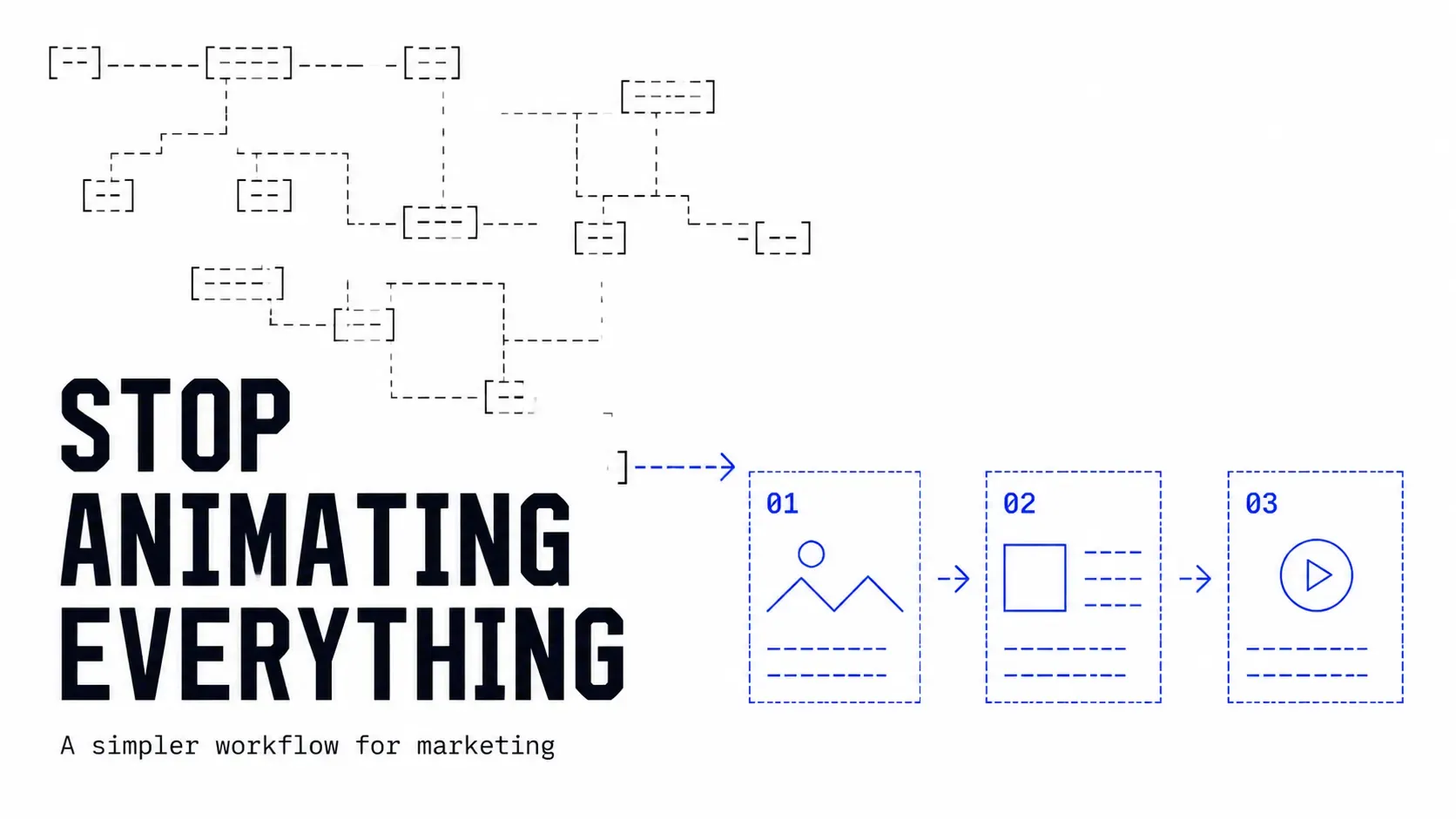
After Effects is not too complicated. That framing is wrong and it leads teams to the wrong replacement.
After Effects is a compositor. It is built for the case where the motion is the deliverable: title sequences, broadcast identities, visual effects, anything where a designer needs frame-level control over what every pixel does. For that work it is not overkill, it is the correct tool, and no scene-based product will replace it.
The question is whether that is your problem.
The test
Ask one thing about the video you need this quarter:
Is the motion the message, or is the motion carrying a message?
If a designer is going to spend two days deciding how a logo resolves, the motion is the message. Use After Effects.
If you need a 30 second film that explains a new feature to people who have never seen it, the motion is carrying a message, and everything the timeline gives you is overhead against the thing you are actually optimising: whether the viewer understood.
What the timeline costs when the motion is not the point
A keyframe timeline is a very general instrument. That generality has three specific costs for product video:
Every value is a decision. How long does this card take to arrive? The timeline has no opinion, so somebody picks 12 frames because it looked right, and a different person picks 20 frames on the next scene. The film ends up with no rhythm because nothing ever established one.
Structure is implicit. A timeline is a flat sequence of layers over time. "Scene three" is a region somebody agreed to call scene three. Cut four seconds from scene two and everything downstream shifts by hand.
Revisions are expensive in the wrong place. Product video changes constantly, and almost always at the level of what a scene says, not how a shape moves. On a timeline those two are entangled.
What a scene-based tool gives up, honestly
It is worth being clear about the trade, because a tool that claims to give up nothing is lying.
You lose frame-level control. You cannot hand-animate a bezier path, build a particle system, or composite in a way the tool did not anticipate. You are working inside a vocabulary somebody else chose.
That is a real loss. It is only a good trade when the vocabulary is large enough to say what you need and opinionated enough to say it well.
What "opinionated enough" means in numbers
The useful version of an opinionated tool is not one that hides settings. It is one that has already done the arithmetic you would otherwise get wrong.
Concretely, that means the tool knows things like:
- Display copy is read at about 160 words per minute, and every line needs 900ms on screen before its word count matters at all. So a six second scene holds roughly 13 words, and the tool can tell you when you have written twenty.
- An element arriving reads correctly between 250 and 600ms. Under 80ms it is not motion at all, just a state change, and any easing was wasted.
- An exit should run about two thirds of its entrance, because the viewer has already read the thing that is leaving.
- On a vertical frame, the platform covers roughly the bottom 22% and right 10%. A CTA there is invisible no matter how well it animates.
A timeline will happily let you violate all four. That is not a bug in After Effects. It is what a general tool is.
How to decide
Keep After Effects if any of these are true:
- Motion design is a job title on your team, not a task on someone's list.
- The brand system depends on custom animation that a preset vocabulary cannot express.
- You ship a handful of high-craft films a year and the craft is the point.
Look at a scene-based tool if these are true instead:
- The bottleneck is how many videos you ship, not how elaborate each one is.
- The person who knows what the video should say is not the person who can animate it.
- Videos get revised more than they get built, and the revisions are about wording and ordering.
- Nobody on the team can currently tell you why a transition is 12 frames.
Most marketing teams are in the second list and buying for the first.
Scenivia takes a brief and some screenshots and plans a five to ten scene film against a 15, 30 or 60 second budget, with the timing above applied rather than left to a guess. Join the waitlist.